
-
Webservice Request/Response Validation
Description The LogicNets WebService Framework (WSF) offers tools that allow you to validate the requests and responses of inbound web service calls based on an Open API-based specification (https:…
-
Using the Test Manager: Required Configuration Steps
To use the LogicNets Test Manager with the Assessment Framework applications you must first set up a few things in Access Management. These steps assume that your installation build includes the Test…
-
Style Tab Options for Text, Radio, Checklist, Dropdown, Date, and Number Inputs
Description LogicNets' frameworks contain existing templates that manage the look of your applications, allowing you to concentrate on modeling your content.…

-
Working with Test Cases
Description A test case is a set of actions or instructions that help confirm whether your LogicNets-based application is working as expected. It consists of one or more steps that the system…
-
Question State (Editable, Readonly, Hidden) Based on Prior Values
This feature comes with the FHIR Questionnaire Runtime component and is available through options in the associated part editors. It is applicable to input nodes, such as radiolists, checklists,…
-
Working with Test Suites
Description A test suite is a collection of related test cases that you can manage and run as a single unit. You can execute and have the system run them together in a sequence.…
-
KC Free Text Search (BETA)
Description The freetextsearch part allows you to search a Knowledge Center, for example, allowing your application users to look for all occurrences of a search term in the application's Knowledge…
-
Download a Deployment Image
In addition to deploying an image, you can also download it. If you download an image, the system downloads a zip file containing a list of files. The name of the zip file is the image digest.…
-
Validate Published Packages on Target Instance
Click the Validate button to check if the list of published packages have already been published on the target instance. If you are deploying the package for the first time, the system displays OK.…
-
Create an Image
To create an image, select a configuration and click the Create Image button. The system will display a popup window containing a mandatory tag field. This tag field must be unique for your image and…
-
Clone a Configuration
In the Configuration Manager, you can clone an existing configuration by selecting it and clicking Clone. The system prompts you to enter a unique configuration name,…
-
Delete a Configuration
A configuration contains details of all the workspaces, projects, revisions, packages, and deployment images associated with that configuration. You can delete an existing configuration by selecting…
-
Modify a Configuration
A configuration contains details of all the workspaces, projects, revisions, packages, and deployment images associated with that configuration. To modify an existing configuration,…
-
Uninstall a Deployment Set
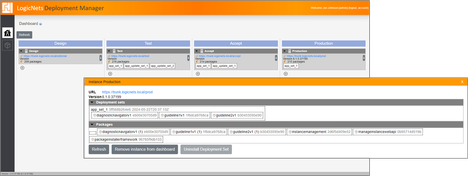
To uninstall a deployment set from the server, select the package from the dashboard and click Uninstall Deployment Set. The system will uninstall the package.…
-
Add or Remove an Instance
An instance is a specific environment in which you can deploy packages, and the environment has a URL that contains a root and a company. Normally, companies will move a package through a series of…
-
Introduction to the Deployment Manager
Available as of LogicNets v8.1, the Deployment Manager allows users with assigned privileges to create deployment configurations, build deployment images,…
-
Report-Item Form Part
Description The report-item is a form part used in the Assessment Framework. It allows you to "echo back" the selections or text entries from users on the left side of the screen as reports on the…

-
Question State Example Project
For details on this feature, go to the Question State (editable, readonly, hidden) Based on Prior Values article. Download this project and import into your Designer,…

-
Get Languages
Description Available in v8.2+, the get_languages part allows you to call and create a collection of languages that you configured in the project settings for your project.…
-
Team (group) vs Individual (strict) Version Control
When you use version control, the system checks out and locks projects at the Workspace/Designer level. However, you can set up your workspace(s) to allow for team control versioning or for stricter…
-
Clickable Image Radio List or Checklist
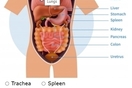
Clickable Image Maps For Release 7.4.5+, you can use an image map with defined areas as a radiolist or checklist input. When clicking on an area, which can be a rectangle, circle,…
-
Update an Expected Test Case Response
When comparing testing responses, there are times you may want to update the expected response based on the comparison. To use the actual response as the expected response,…
-
Compare Test Cases
The Test Manager allows you to compare the expected and actual responses of a test case. To do this, select a test case. The system displays the list of previous runs in the Run Details section.…
-
Create a Sub-Test Suite
The Test Manager allows you to create sub-test suites, which are test suites within a test suite. To create a sub-test suite, select an existing test suite and click the Create Sub Test Suite button.…
-
Test Manager Inbox
Test Manager Inbox The inbox is where you can select which test cases to move into a test suite.