
Introduction to the Deployment Manager
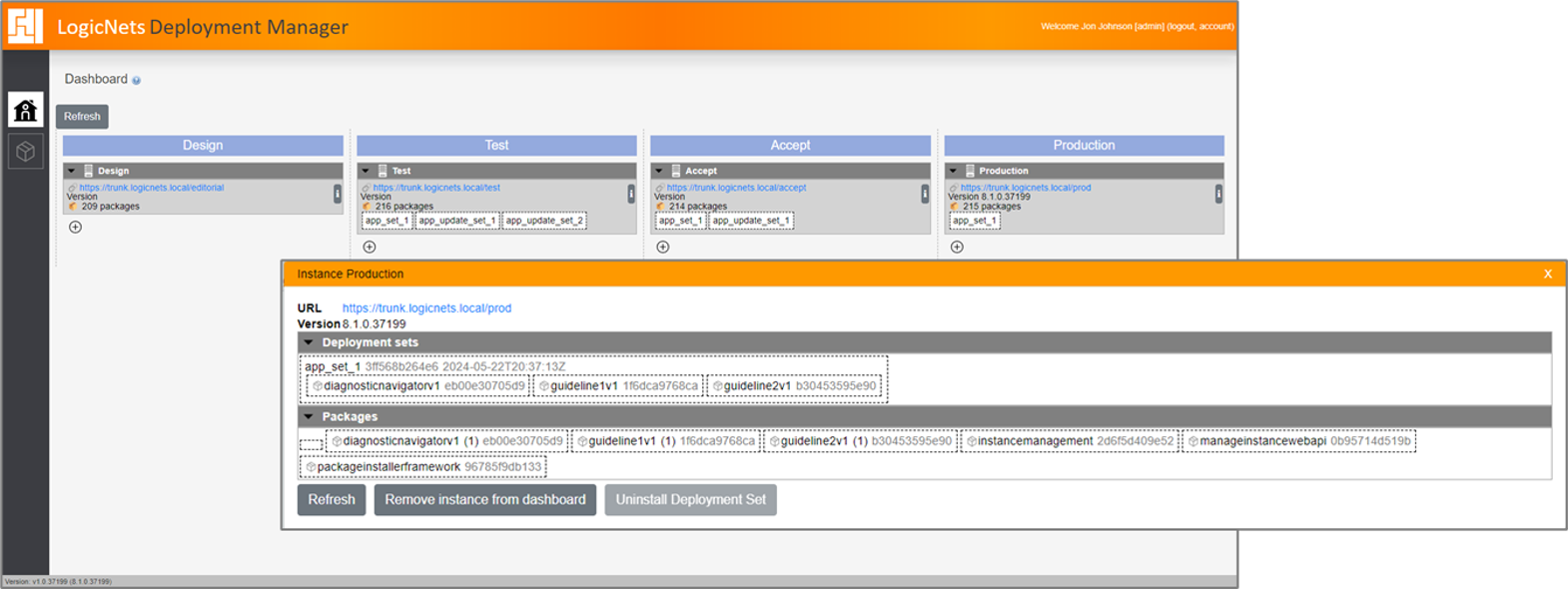
Available as of LogicNets v8.1, the Deployment Manager allows users with assigned privileges to create deployment configurations, build deployment images, and deploy those images to identified instances. This allows you to manage the deployment of multiple applications, including frameworks and libraries, to one or more test or production servers at once, instead of publishing and installing individual packages on individual installations.
- A deployment configuration defines the project or projects you want to publish and bundles them into a deployment image.
- A deployment image is the zipped file set of published packages that you can deploy to or remove from a target instance.
The topics in this section walk you through how to configure Deployment Manager access and to add and deploy deployment sets. Click on the Deployment Manager category above, or here to access the list of articles that detail the following actions:
- Configure the access and roles.
- Add instances.
- Create and modify a deployment configuration set.
- Create a deployment image of the latest revisions.
- Deploy the image to an instance.
Steps 3 to 5 are part of the workflow for your defined set of projects. They replace multiple individual, manual processes required to update a test or production instance of your projects. Additionally, you can easily uninstall a deployment set and roll back to a prior image in case of a runtime error.
Commercial Details
For commercial information about the LogicNets Deployment Manager go to the LogicNets Deployment Manager (LN-WSP-D) Product page here.
Reply
Content aside
- 1 yr agoLast active
- 50Views
-
2
Following