
-
Introduction to the Deployment Manager
Available as of LogicNets v8.1, the Deployment Manager allows users with assigned privileges to create deployment configurations, build deployment images,…
-
Deployment Manager Prerequisites and Roles
Prerequisites To use the Deployment Manager, your LogicNets installation must specifically include it. It is an optional, add-on component of the Shared Workspaces license.…
-
Deployment Manager Dashboard
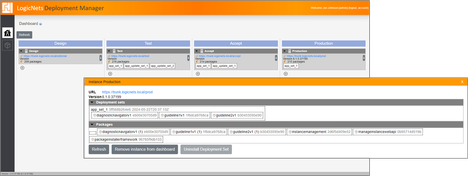
The Deployment Manager dashboard allows you to see and manage deployments in each stage of development, test, accept, and production (DTAP) process. It is your central point for creating, managing,…
-
Add or Remove an Instance
An instance is a specific environment in which you can deploy packages, and the environment has a URL that contains a root and a company. Normally, companies will move a package through a series of…
-
Deployment Manager Configurations
A Deployment Manager configuration contains details of all the workspaces, projects, revisions, packages, and deployment images associated with it. You create a configuration in an instance,…
-
Create a New Configuration
A configuration contains details of all the workspaces, projects, revisions, packages, and deployment images associated with that configuration. To add a new configuration click the + sign on the…
-
Modify a Configuration
A configuration contains details of all the workspaces, projects, revisions, packages, and deployment images associated with that configuration. To modify an existing configuration,…
-
Delete a Configuration
A configuration contains details of all the workspaces, projects, revisions, packages, and deployment images associated with that configuration. You can delete an existing configuration by selecting…
-
Clone a Configuration
In the Configuration Manager, you can clone an existing configuration by selecting it and clicking Clone. The system prompts you to enter a unique configuration name,…
-
Deployment Images
Once you create a configuration, you can use that configuration to create a deployment image. A deployment image contains a list of published packages and a configuration file that can be deployed on…
-
Create an Image
To create an image, select a configuration and click the Create Image button. The system will display a popup window containing a mandatory tag field. This tag field must be unique for your image and…
-
Deploying an Image
After the system validates the list of packages, you can then choose whether to deploy this image on the target server. If you click Deploy the system installs all the packages in an image on the…
-
Validate Published Packages on Target Instance
Click the Validate button to check if the list of published packages have already been published on the target instance. If you are deploying the package for the first time, the system displays OK.…
-
Download a Deployment Image
In addition to deploying an image, you can also download it. If you download an image, the system downloads a zip file containing a list of files. The name of the zip file is the image digest.…
-
Uninstall a Deployment Set
To uninstall a deployment set from the server, select the package from the dashboard and click Uninstall Deployment Set. The system will uninstall the package.…
-
Support Load-Balanced Instances
Description The Deployment Manager provides customers with tools to manage small- and large-scale installations. This functionality includes the ability to use load balancers to redirect traffic to a…
-
Parallel Version Support: Setting Prefix and Postfixes, Start Codes, and Library Links
Description In v8.3, LogicNets introduced parallel version support functionality as part of the Deployment Manager. This adds support for publishing package names using startcode prefixes and…
The following topics walk you through how to add, configure, and work with the Deployment Manager functionality.